
The bonefish is a carnivore that feeds on smaller animals. They are found in tropical and subtropical waters around the world.
Their diet consists mainly of small fish, but they will also eat worms, molluscs, shrimp and tiny crabs. Bonefish are important predators in the food web and help to keep the populations of smaller fish, shrimps, worms and molluscs in check.
They have a laterally compressed body that helps them move through the water quickly. Bonefish are fast swimmers and can reach speeds of up to 40 miles per hour, which helps then in their hunting!
Some of the most common food items eaten by bonefish are:
- Worms
- Shrimp
- Molluscs
- Small crabs
- Snails
- Small fish
Habitat and diet of the bonefish
Bonefish are marine fish that live in tropical and subtropical waters around the world. They live on flats, muddy areas. They like to live in quiet, shallow water, especially around vegetation and coral reefs.
Why do bonefish live in shallow water?
Bonefish live in shallow water because they need to be able to see their prey. Bonefish have small eyes, so they need to stay close to the water surface.
Primary Diet of the bonefish
Bonefish are mostly carnivores that eat small fish, crustaceans, and molluscs. They mainly eat smaller fish and shrimp, but they also eat worms and molluscs.
Feeding habits and digestion
Bonefish become well fed by gorging on small fish, crustaceans, and molluscs. Their digestive system processes the large amount of food they eat.
Bonefish have thin, sharp teeth that extend from their jaws. They also have sharp, bony plates that grow from their heads. These plates are called scutes. Bonefish use their scutes to fight their enemies.
Their teeth, jaws, and stomach have a special adaptation to help them digest their food. Their teeth are strong enough to crush and extract even larger crabs and mussels from their shell.
Is a bonefish a producer, consumer or decomposer?
Because bonefish only eat animals, they are consumers and not producers or decomposers. There are four types of consumers: omnivores, carnivores, herbivores and decomposers.
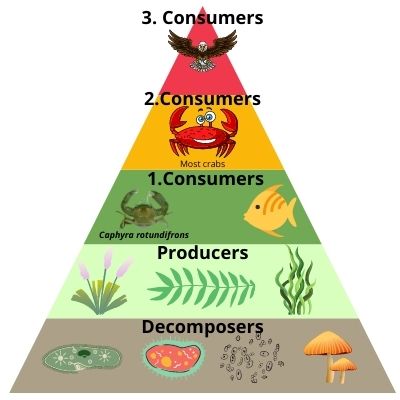
Bonefish are carnivores and thus secondary consumers.
Is a bonefish an autotroph or a heterotroph?
Bonefish are heterotrophs because they eat other living organisms. Practically no animals are autotrophic because animals do not get their energy directly from the sun like plants do. That is, animals like the bonefish cannot make their own energy!
Where are bonefish in the food chain?
Bonefish are secondary consumers so they are located in the middle of the food chain. A secondary consumer is any animal that eat primary consumers. That is, they eat animals that eat plants. When a bonefish eats a primary consumer, such as a shrimp, the bonefish becomes a secondary consumer.
What animals prey on bonefish?
The stingrays (Raja), sharks (Carcharodon) and tarpon (Istiophorus) and, not the least, humans, are all predators that prey on the bonefish.
While bonefish may be high up in the food chain, they are not without their own predators. When a bonefish is hunting, it is usually harassed by smaller fish that try to chase it away, as well as larger fish that try to eat it. Sharks and dolphins also feed on bonefish.
Conclusion
The bonefish, or permit, is a small, slender and fascinating fish. It is a member of the sciaenid family of fish and is often referred to as an ocean perch. It is characterized by its bonelike head, small eyes, coloration and, of course, its particular diet. It has a narrow, forked tail and a small mouth, which is the only one in the house of flounders.
The diet of many of us only consists of fish, chicken, steak, pasta, rice and some vegetables. The bonefis
A bonefish is a species of fish that lives in shallow, tropical waters. They are an important part of the ecosystem because they help to keep the water clean by eating zooplankton and other small organisms.
Bonefish are also a source of food for other animals in the ecosystem. Some people eat bonefish as a food source, and they are very popular game fish in amateur fishing.
The quality of the bonefish’s diet depends on the availability of plants, and the prey’s behaviour in the wild.


